Showing posts with label movie review. Show all posts

Thursday, August 21, 2014

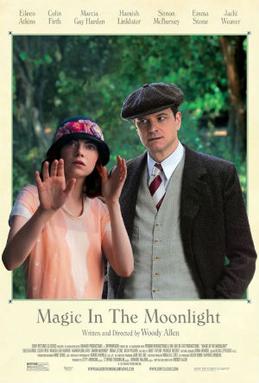
Less than Magical: Magic in the Moonlight Review

If this looks like the poster of a bad romantic comedy, I have bad news.

There is no mystery about this being a Woody Allen film: opening titles are nearly identical to the ones I saw at the beginning of Midnight in Paris, and given that both films are set in France and deal with the fantastic almost makes Magic in the Moonlight a companion piece to Allen’s 2011 work. In a way, Magic is a love letter to the French Riviera as many shots focus on the view of the sea from the verdant countryside. This will please the Francophile, but I did not fall in love with the shots. In the end, Magic in the Moonlight ends up an inferior iteration in Allen’s film catalog.

An ideal critic will no doubt cast this film in the context of Allen’s career as a whole; unfortunately, I can’t really do that. There are only three Woody Allen films that I’ve seen in their entireties: Annie Hall, Midnight in Paris, and Magic in the Moonlight. Ranking them in such a small selection is meritless since it ignores a nearly fifty years in filmmaking. And yet, I can’t help but put Magic against the other two. Annie Hall is the beloved masterpiece, Midnight is the work that reinforces audiences’ confidence in Allen’s abilities in his later years, but Magic seems to reveal a moment of weakness.

Magic is well-acted, especially with the two leads, Colin Firth and Emma Stone. Firth’s ardent skeptic Stanley plays inquisitor for Stone’s young mystic Sophie. Despite their fine performances, the chemistry between their characters feels forced in that Sophie seems to fall for the grumpy Stanley all too easily. It was as if Allen wanted us to find Stanley more charming than he truly comes across. What makes it even more infuriating is that Stanley is assuredly the Allen stand-in, giving the character a sort of Gary Stu problem in that he’s super intelligent and has a strange yet strong animal magnetism that draws in the young and naïve Sophie. Thankfully, Stanley is not depicted in such a way that he’s perfect in every aspect, but his negative qualities almost seem as they’re supposed to be overlooked.

I found myself restless throughout many moments in the movie, which is a rare thing. There’s some tension about whether or not Sophie’s truly a psychic, but never was I captivated by scenery or performances, instead wondering what would make this more than a whodunit with a love story. But it’s a bad whodunit with a weak love story. Amusing at times, but never once enthralling.

Wednesday, August 6, 2014

I Laughed at a Sentient Sapling Dancing to the Jackson 5: Guardians of the Galaxy Review

Needs more Peter Serafinowicz.

By all means, it should not have succeeded. Andy Dwyer of Parks and Rec should not be a roguish space hero. The guy who made Super should not do a comic book movie. Vin Diesel should not be a tree. A talking, gun-toting raccoon should not work. And yet, in spite of all these and many other factors, this movie works even better than the rest of the Marvel catalogue. Yes, even The Avengers.

Guardians of the Galaxy is and isn’t a superhero movie. It’s an epic space opera that makes for a better Star Wars movie than the Star Wars prequels. Our Han Solo-type is out to make a buck and look what happens—he gets embroiled in a desperate attempt to save the galaxy from certain destruction. He even makes a few buddies along the way. And yet, somehow, all of this is happening in the same universe in which an eccentric arms manufacturer teams up with a Norse god, an irradiated strong man with rage problems, a thawed out WWII super soldier—maybe it’s not so crazy.

But the film itself is insane, or at the very least weird. A lot of effort went in to making this alien and spacy. We don’t need to be told this is in a galaxy far, far away. The images do it for us. Humanoids of varying shades and hues walk in the backgrounds and foregrounds, and the locales are peppered with utopian futuristic architecture and gritty spacer aesthetics. There’s an entire sequence that takes place in a dead giant being’s head that’s being mined out for its riches. It’s reminiscent of the magazine Heavy Metal if its content was toned down for PG13 audiences. It’s very much a comic book movie, and it’s perhaps the best at being that.

The movie serves as a further evidence that the Marvel film brand is stronger than ever and almost certainly stronger than D.C.’s. Marvel was willing to take a risk on an unproven intellectual property, knowing full well that if it fails they’ve got the rest of the Marvel Cinematic Universe to fall back on. Meanwhile, D.C. struggles to slap together a Batman and Superman movie without doing anything to string them together beyond keeping the same Superman actor. It’s this brazen confidence in Marvel’s property that no doubt supports Guardians’ success.

Chris Pratt does a fine job as Peter Quill, earth boy raised by space scavengers. He’s as hilarious as we’ve come to expect given his performances on Parks and Recreation and in The Lego Movie. Bradley Cooper plays the mouthy anthropomorphic raccoon Rocket who was not as annoying as I had expected. For a tree, Groot is surprisingly emotive, though more of that is owed to the animators and not necessarily Vin Diesel’s performance, though that’s not to say he did terribly. He did fine for a talking tree. Dave Batista plays our psychopathic strong man bent on vengeance, and for as angry and serious as he was, he chimed in with some great comedic moments for himself. The weakest performance here seemed to be Zoe Saldana as Gamora, due in part to her noticeably less frequent comedic timing than the rest of the characters. She plays the vengeful assassin lady admirably, but she doesn’t seem to have as much fun as the rest of the actors.


At the end, I’m left wondering how this film will merge with the rest of the MCU or if it even has to. Word is we have a sequel in the works for Guardians already, and while I’m happy to hear it, I’d be even happier if they keep it on that end of the galaxy and not ours. There’s so much more to see in Guardians’ self-contained universe. We could use a good space opera franchise right now, especially when we’ve been burned by other space opera franchises in the past. 

Wednesday, July 16, 2014

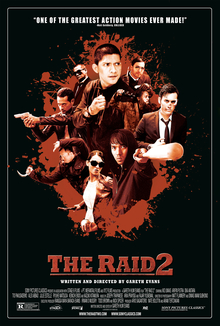
Unconventional and Improvised Weapons, The Sequel: A Review of The Raid 2

Now with less subtitle!

I was at friend’s apartment when his roommate emerged from his room with a face of satisfied exasperation. “What did you watch?” my friend asked. “The Raid,” the roommate said. Only a couple months later, the movie showed up in the Redbox near my apartment. I rented it, and then never returned it. They charged me full price for the movie. I was okay with that.

The Raid 2 I will be returning to the Redbox, but I hope to buy it later. As a sequel, it does everything it should: expands the scope of the film by upping the blood, multiplying the cast, and leaving the setting of the original. There are moments in the first movie that might make you cringe, but there are scenes that could make you outright queasy. And there’s a lot of them. For instance, in the The Raid, there’s a part where our protagonist Rama hides behind a wall from a machete-wielding thug. Suspicious of what might hide behind the wall, the thug stabs randomly. One stab grazes Rama’s cheek, and Rama must then wipe the blood off the blade as it’s retracted not to give away his presence. It’s a scene that works on multiple levels, but most importantly the fact that this is a wound that people can relate to. It’s not a terribly deep cut, and the pain is familiar enough that it might recall a memory to a previous cut. Cue the cringe.

None of that occurs in The Raid 2. The violence here is gritty but borderline fantastical compared to that of the original. It seems outrageous at times, but it’s mesmerizing to watch. There’s a scene in which a woman wearing sunglasses armed with two claw hammers takes out at least six men with Japanese daggers. The camerawork is intimidate since we’re on a subway train, and the woman makes liberal use of the claw side of the hammer. As you can guess, blood comes out in buckets during this scene, and it lasts all of about a couple minutes. The sounds, the close-ups of hammer claws buried into necks are harder to watch than in the first movie. Then again, The Raid 2 is more dangerous. The stakes are higher.

The Raid 2 is an immediate continuation of the first film. The traitor of the first film is seen at its beginning, and Rama is convinced to assist a cop with infiltrating a mob. His only qualifications for this are that he can kick a metric ton of asses and that he came out mostly unharmed from the titular raid of the first film. Of course, the cop makes a deal Rama can’t refuse: he’ll protect Rama’s wife and son. The wife is pregnant at the beginning of the first film. Rama is established as a family man both in trying to retrieve his gangster brother and saying reserved goodbyes to his pregnant wife. The family man angle is turned against him in The Raid 2, which makes Rama’s plight all the more engaging.

There’s even a running theme of distant fathers throughout the movie, as Uco vies desperately for his gangster father’s approval, a shabby hitman wants to reconnect with his son, and Rama stays in quiet contact with his wife. Due to this desire to introduce more plot and conflict, the film suffers at time in its pacing. At nearly two and a half hours, it’s a gamble to increase the exposition in a film that about dudes beating up other dudes, and the moments of downtime takes away that breakneck pace that we get in the original film. Also, dad conflicts are too convenient for a movie like this, but it helps to emphasize Rama’s concerns about staying alive long enough to be a dad.

Beyond fatherhood, Rama also evolves in fighting style. He takes on the persona of Yuda, a young hood who ends up in prison kicking the crap out of someone. He then befriends Uco, the heir of a crime family in Jakarta, in an attempt to infiltrate Uco’s syndicate. When not fighting, Rama comes across as an earnest worker doing the best that he can. However, when locked in combat, he becomes more brutal, nearly sadistic, than we see in the first film. In The Raid, he’s fighting for survival. In The Raid 2, there’s something else. It’s never clear if this propensity to violence is merely him maintaining his façade of Yuda, but it’s clear that we have a different Rama than in the first movie.

In spite of the film’s iffy pacing, The Raid 2 must be praised for its cinematography. Color palettes are played with in a noticeable and intriguing way. One setting in particular is saturated with red, giving the impression that the film is culminating to a bloody conclusion, which is accurate. That camera work has its moments of shakiness but it’s never in a nauseating way. There is, however, a car chase that does some bold moves with camera work in which the camera seems to fly into the passenger seat of a car but from a great distance in front of that car. A moment like that car chase reminds me why I was excited about the movie. The Raid 2 is the bigger, badder sequel that we thought we wanted. It’s still immensely fun to watch, but in trying to make more plot, it loses the charming relentlessness of the original.