Wednesday, July 16, 2014

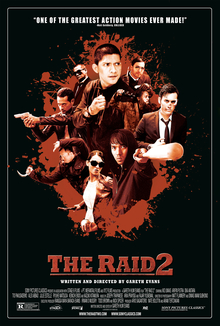
Unconventional and Improvised Weapons, The Sequel: A Review of The Raid 2

Now with less subtitle!

I was at friend’s apartment when his roommate emerged from his room with a face of satisfied exasperation. “What did you watch?” my friend asked. “The Raid,” the roommate said. Only a couple months later, the movie showed up in the Redbox near my apartment. I rented it, and then never returned it. They charged me full price for the movie. I was okay with that.

The Raid 2 I will be returning to the Redbox, but I hope to buy it later. As a sequel, it does everything it should: expands the scope of the film by upping the blood, multiplying the cast, and leaving the setting of the original. There are moments in the first movie that might make you cringe, but there are scenes that could make you outright queasy. And there’s a lot of them. For instance, in the The Raid, there’s a part where our protagonist Rama hides behind a wall from a machete-wielding thug. Suspicious of what might hide behind the wall, the thug stabs randomly. One stab grazes Rama’s cheek, and Rama must then wipe the blood off the blade as it’s retracted not to give away his presence. It’s a scene that works on multiple levels, but most importantly the fact that this is a wound that people can relate to. It’s not a terribly deep cut, and the pain is familiar enough that it might recall a memory to a previous cut. Cue the cringe.

None of that occurs in The Raid 2. The violence here is gritty but borderline fantastical compared to that of the original. It seems outrageous at times, but it’s mesmerizing to watch. There’s a scene in which a woman wearing sunglasses armed with two claw hammers takes out at least six men with Japanese daggers. The camerawork is intimidate since we’re on a subway train, and the woman makes liberal use of the claw side of the hammer. As you can guess, blood comes out in buckets during this scene, and it lasts all of about a couple minutes. The sounds, the close-ups of hammer claws buried into necks are harder to watch than in the first movie. Then again, The Raid 2 is more dangerous. The stakes are higher.

The Raid 2 is an immediate continuation of the first film. The traitor of the first film is seen at its beginning, and Rama is convinced to assist a cop with infiltrating a mob. His only qualifications for this are that he can kick a metric ton of asses and that he came out mostly unharmed from the titular raid of the first film. Of course, the cop makes a deal Rama can’t refuse: he’ll protect Rama’s wife and son. The wife is pregnant at the beginning of the first film. Rama is established as a family man both in trying to retrieve his gangster brother and saying reserved goodbyes to his pregnant wife. The family man angle is turned against him in The Raid 2, which makes Rama’s plight all the more engaging.

There’s even a running theme of distant fathers throughout the movie, as Uco vies desperately for his gangster father’s approval, a shabby hitman wants to reconnect with his son, and Rama stays in quiet contact with his wife. Due to this desire to introduce more plot and conflict, the film suffers at time in its pacing. At nearly two and a half hours, it’s a gamble to increase the exposition in a film that about dudes beating up other dudes, and the moments of downtime takes away that breakneck pace that we get in the original film. Also, dad conflicts are too convenient for a movie like this, but it helps to emphasize Rama’s concerns about staying alive long enough to be a dad.

Beyond fatherhood, Rama also evolves in fighting style. He takes on the persona of Yuda, a young hood who ends up in prison kicking the crap out of someone. He then befriends Uco, the heir of a crime family in Jakarta, in an attempt to infiltrate Uco’s syndicate. When not fighting, Rama comes across as an earnest worker doing the best that he can. However, when locked in combat, he becomes more brutal, nearly sadistic, than we see in the first film. In The Raid, he’s fighting for survival. In The Raid 2, there’s something else. It’s never clear if this propensity to violence is merely him maintaining his façade of Yuda, but it’s clear that we have a different Rama than in the first movie.

In spite of the film’s iffy pacing, The Raid 2 must be praised for its cinematography. Color palettes are played with in a noticeable and intriguing way. One setting in particular is saturated with red, giving the impression that the film is culminating to a bloody conclusion, which is accurate. That camera work has its moments of shakiness but it’s never in a nauseating way. There is, however, a car chase that does some bold moves with camera work in which the camera seems to fly into the passenger seat of a car but from a great distance in front of that car. A moment like that car chase reminds me why I was excited about the movie. The Raid 2 is the bigger, badder sequel that we thought we wanted. It’s still immensely fun to watch, but in trying to make more plot, it loses the charming relentlessness of the original. 

Tuesday, July 15, 2014

Pokémon’s Balls: The Cruelty of Choice in Pokémon

Just like what I played, but redder.

The original Pokémon was a simple game. Simple graphics, simple mechanics--it was a game that pushed the boundaries of the JRPG genre by rethinking the role of the player: no longer a member of an adventuring party, now the sole adventurer. Building up and optimizing your party was the entirety of the game. Simply put, you wanted to be “To be the very best.” You wanted to be a Pokémon Master.

The party wasn't a collective of ragtag adventurers but strange animals with special powers doing their master’s bidding. The game stressed the term master in a peculiar way. This was not a master-to-slave relationship but a master-to-pet. However, a Pokémon Master was not merely the master of his Pokémon but a master of training, a master of the very concept of Pokémon. It’s no surprise, then, that a premium item is called the “Master Ball.”

Pokémon came out in the U.S. in 1998. I got Pokémon Blue for Christmas along with a Game Boy Color. I was absorbed quickly into the Pokémon zeitgeist. I had games, music CDs, a trading card game, a board game--it was an intense obsession for a ten-year-old, but one that quickly fizzled out. The multimedia juggernaut was like propaganda espousing the virtues of becoming a Pokémon Master. Even the compilation of Pokémon-inspired tunes was called 2 B. A. Master.

Mastery is the theme of the game. You don’t just play to the end. You play to conquer the system. Fight and train them with other Pokémon. Capture with Pokéballs. Many small steps up to the conclusion. Despite its simplicity, it’s not a game I ever fully understood when I played it. At ten, I mashed the A-button on my Game Boy so rapidly and forcefully that it’s any surprise that the button didn’t just fall out of the device. I saw the menus flash and ignored them. I was too impatient. I wanted to see my Blastoise send a barrage of bubbles from his shell-mounted cannons. Early on, the game explicitly suggests that you switch out your Pokémon so they all get a piece of the action and earn experience points. But I wanted my Blastoise to be the best. He was my prized turtle tank.

Near the game’s end, you encounter a unique Pokémon: Mewtwo. Unlike other Pokémon, there’s only one of him, and he himself is a clone of another unique Pokémon who’s never seen in the original game. He’s powerful, maybe even a game changer if you can snag him, but it’s extremely difficult unless you have a special item. I never caught him. Just as unique is Mewtwo is the special item in question: the Master Ball. Most Pokéballs could be busted out of by wild Pokémon, even Pokéballs that were designated “Ultra.” And while you could capture Mewtwo using an Ultra Ball, it required patience and precision. You couldn’t knock him out or he’d be lost forever, but you had to drop his health bar to a sliver. Otherwise, you used a Master Ball.

When you’re given the Master Ball, you’re told it’s the only one of its kind. You can use it to capture any Pokemon, but once you use it, it’s done used. I don’t remember what I caught with my Master Ball, but I know damn well it wasn’t Mewtwo. The game poses one hell of a choice to you for a game intended for ten-year-olds. It’s as if the makers were saying, We’re going to give you this special item, but we’re not going to tell you what you should specifically save it for . . . we’ll let you screw it up. It’s not a choice you get terribly early in the game, either. One of the earliest choices, however, seems more heinous.

As is the choice with every Pokémon game to date, you have to pick a Pokémon that will be your first. The three main elemental Pokémon: a grass-type, a water-type, and a fire-type. They are rock-paper-scissors incarnate--the fire-type is vulnerable to the water-type and so on. Every time, no matter what you choose, your designated rival picks your weakness. While it is certainly a way of encouraging the player to not only diversify their party, it suggests a futility in choice. No matter what you pick, a bigger obstacle awaits. It was frustrating then. It’s somehow still frustrating, even though I haven’t played Pokémon since I was twelve. No matter what I did, my rival would pick my kryptonite just to throw it at me every once in a while. But that’s why you choose other Pokémon to take care of that.

In the current generation of video games, choice is mechanically built into games. The Witcher series of games is a tragic love letter to the very idea of choice: whole levels are opened and closed based on a few difficult choices. The Mass Effect trilogy emphasizes how your decisions will affect the endgame. But none shares the audacity of Pokémon's forced choices. Those are games intended for adults who are used to critical thinking; Pokémon's for kids still working on that skill. Perhaps Japan's standards for maturity and critical thinking played into the design decision that granted ten-year-olds the responsibility of deciding what to do with a high-value item. Or maybe it was just a weakness of my own decision making skills at age ten.

In the anime, Pokémon’s main character selected his fighters with the phrase, “I choose you!” Pokémon Mastery was a series of choices. Good choices or bad, it didn’t matter. You either had a good payoff or a dire consequence. I defeated the Elite Four, the final bosses of the game, but even as the game credits rolled I didn't feel the game was done. Mewtwo was unconscious in a cave somewhere and not in my service. I had achieved victory, but no mastery.

Saturday, July 12, 2014

Burger Lab: Experiment #1

This past week, I had a burger craving. I didn't want a fast food burger, and I didn't want to put up the scratch for a burger at one of the classier joints here in town, so I decided to Build-A-Burger. Kroger is just a five minute walk from our apartment, so I took a trip to pick up a few of the necessary items. I stuck to the basics: Kroger-brand hamburger buns, 73% lean ground beef, and Kraft Deluxe American singles.

I considered truly making this an experiment, grabbing what spices and ingredients I could find in our tiny kitchen and infusing it with the ground beef. I'd made Ernest Hemingway's manburger a few months back, but the recipe called for all things exotic in the land of the burger like red wine and relish. But, like all good experiments, I needed a control group first. I went completely plain.

No salt, no pepper. Nothing at all in the burger patty except the meat itself. I formed three patties out of the one pound of hamburger meat. Two I wrapped in parchment paper and placed in Ziploc bags in the freezer. The third was mine that day.

Spraying down a thin layer of canola oil on a skillet, I let it heat at medium-high. As soon as I dropped the uncooked meat onto the skillet, the sizzle let me know I was in business. Four minutes seemed an ample time to let it cook on one side. Then I remembered the inherent problem with using the skillet: the hot splash of grease that bursts forth like a small stinging fountain. Spots of sepia dotted the white surface of the stove, forming a silhouette around the pan. I cleaned as I went, unable to cover it because there was no lid for the skillet. I was focused--determined to cook a basic burger.

Four minutes up and I flipped the burger with difficulty. My spatula did not slide under the burger as easily as I had imagined it would, so it pushed it up to the edge. Pangs of panic shot through me as I dreaded pushing the half-cooked patty onto the stove, causing further mess and inconvenience. Finally, I gritted my teeth and used my free hand to negotiate the patty onto my spatula, hot needles poking at my skin.

Four more minutes. Almost home. The outside was black and brown, but mostly black from the skillet. I wondered if it wasn't as cooked as I had hoped. I wondered if I'd be missing a day or two of work because of a burger blunder. What joy.

Three minutes in and I took a slice of cheese I had at the ready and blanketed the burger's naked surface in processed yellow. Heat made the slice wrap itself tighter across the surface, almost to the point where the four corners touched the pan. By that point, the final minute passed and it was time to enjoy the product of my labors. Bun opened, I lay the burger down. Juices ran down the bottom half of the bun. The top half set itself on top like it was destined to stay there. I dug in.

The charred black from the skillet made the burger crunchy but not inedible. I saw that the burger was pink but reasonably cooked, so it was unlikely to cause me much grief in the following days. Overall, I was satisfied. I'm easy to please when it comes to my burgers. But there is more to be done in burger science, a frontier not yet fully discovered.

Wednesday, July 9, 2014

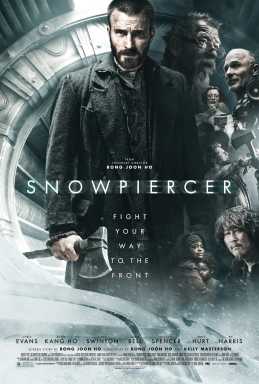
Chris Evans' Beard is Neatly Trimmed in the Post-Apocalypse: A Review of Snowpiercer

Let's play Count the Hatchets.

I often gauge the quality of a movie on how much it keeps me from breathing. The death of brain cells from lack of oxygen might play into that, but this is not a self-diagnosis of brain damage. To get lost in a movie so deeply so as to forget to do such an involuntary action as taking a breath is a hell of a thing to experience. It's a reminder that you're watching something special, maybe even important.

Snowpiercer is special. Usually when a movie captivates me so fully, it happens midway through. Peckinpah's Straw Dogs stopped my breathing in its final act as Dustin Hoffman defends his domicile from the horde of angry drunken Englishmen. The Evil Dead remake of 2013 had a similar effect. The original Old Boy's famed hallway fight didn't even let me blink. Intensity that locks you in and refuses to release you until it decides--that's what these movies share. That's what Snowpiercer has. And a lot more.

Snowpiercer is the marriage of South Korean film sensibilities and French graphic literature. Director Bong Joon-ho, best known for his monster-movie-with-a-message The Host, extracts some fine performances from Chris Evans, Octavia Butler, and Jamie Bell. All of whom play passengers damned to the back of the train carting the remnants of humanity for eternity. Song Kang-ho, lead from The Host, and Go Ah-sung portray a father-daughter pair of drug addicts. Their relationship is genuine and heartwarming without verging onto the sentimental. The strongest performance by far comes from the villainous mouthpiece for the front of the train--the upper crust of society--played by Tilda Swinton. She brings a religious zeal to her character that really drives home the idea that there's a spiritual necessity for an established class system.

It is in this class system we find our strongest conflict: back vs. front, lower class vs. upper class. Out of this conflict, we get some mesmerizing fight sequences. The progression almost plays out like a video game: the ragtag group of caboose dwellers must make their way through several train cars, each one with a different purpose and aesthetic. Their first destination? A prison car. The next? The water treatment car. The further up the line, the cleaner and brighter the cars get. The contrast between rear and front emphasize that the front folk live in a facade, completely oblivious to the plight of the rear.

The first push towards the front immediately reminded me of Old Boy's hallway fight: tight quarters and improvised weapons. Only here, the close quarters are emphasized with tight shots convulsing with the train rumble and the desperate push towards control. Here's where I stopped breathing. The tension builds as we see the characters go through a routine we've already seen play out twice. We know things are a little different as they've dragged barrels out from the rear. When the timing is right, the revolt goes off like a short fuse.

There is some philosophical meat to chew on, and nothing terribly subtle. Thinly-veiled allusions to order and necessary placement appear as if they're meant for meditation but in truth feel more like glorified elements of foreshadowing. That's not to say that they're intellectually unstimulating. In spite of their overt presentation, the ideas of class and order are expressed in bleak but uncertain terms. In keeping with a dystopian spirit, those in control may be brutal but not completely malevolent; they believe in order and its need to keep things in line. It's hard to sympathize with those at the top, but we're not meant to.

In accordance with the Netflix method of rating movies, I give Snowpiercer four stars ( * * * * ), meaning, "I really liked it."

Monday, July 7, 2014

A Tale of Two Snakes: Adjusting to a New Voice from an Old Face

To complain about Metal Gear Solid V: Ground Zeroes' length would be to beat a dead horse, so I won't even bother to pick up a club. It's a tight game, one that's pushed the series further from top-down sneak 'em up gameplay to tactical shooter mechanics that rivals most military shooters on console. The story is compelling, and they waste no opportunities in terms of getting you up to speed. Didn't play side-story game Peace Walker? That's alright. The loading screens are rife with context. Not that it will do you much good. This is a Metal Gear Solid game, after all.

That being said, what little story you do get is good. It's intense. It's much darker than its predecessors, even more so than Metal Gear Solid 4's theme of an aging soldier who may or may not be knocking on death's door. You get some unexpected social commentary with Guantanamo Bay stand-in Camp Omega. All in all, it's clear that Metal Gear Solid is doing some growing up. 

To amp up the maturity levels, Hideo Kojima sought out some Hollywood talent for his cast of battle-hardened characters. Enter Jack Bauer himself: Kiefer Sutherland. The growly son of Donald now voices Snake as opposed to fan favorite David Hayter who, for many people, is the voice of Snake, whether Solid Snake or papa Naked Snake. A lot of folks weren't happy, especially Mr. Hayter himself, and understandably so: Hayter's gravelly intonation was Solid Snake. It only got more gruff when Solid Snake aging sped up in MGS 4, and it felt right. Hayter is Snake.

It's jarring to see the face of a character who is recognizable, regardless of polygon count or texture detail, but instead hear the voice of another, a voice that doesn't quite fit. For over fifteen years, gamers have consistently had the same voice for Solid Snake since his delivery unto a 3D canvas. Why change it now?

It's already evident that MGS V is a game of change. The game is a transition for the main character from protagonist to antagonist. Already, there's a tonal shift between MGS V and its predecessors. In spite of its depressing content, MGS 4 keeps the razors from the wrists with moments of the comedic and bizarre. A gun dealer who looks oddly like Dennis Rodman in Simon Sez with a pet monkey in silver hot pants? MGS 4 is abound with Koijma-san's signature quirk. In the brief window of MGS V, we don't get that with the exception of his Frankenstein-esque, anachronistic iDroiD, but even that is easy to overlook. No guardsmen with diarrhea, no roller skating grenadiers. For a Hideo Kojima production, it's all very straight-forward. 

This is a prequel, of course. Post-origin story, pre-epitaph. This is us seeing Anakin tossed into the lava pit. This is us seeing the hero become the villain. We need to see why Naked Snake becomes Big Boss and why Big Boss becomes hellbent on renouncing his allegiances with private army and a giant robot. Heavy moments are bound to happen. Kojima needs an actor who can handle some emotional weight, and disappointingly maybe Hayter's not cut out for it. 

It's still weird, though. It's like seeing a friend you knew as a kid but didn't see again until after puberty struck: voice is deeper and attitude is different. Not necessarily a bad thing, but it's for damn sure a weird thing. Kiefer Snake is definitely different from Hayter's Naked Snake. Kiefer Snake's seems more haunted, more weighed down by crises. I need more time with Kiefer Snake, but Ground Zeroes is, by all means, a glorified demo. 

Friday, July 4, 2014

Wondering About Wiz: A Review of Todd English P.U.B. in Birmingham, AL

Todd English P.U.B. in Birmingham, AL, is attached to a Westin Hotel, which is in turn attached to a Sheraton (which we stayed at). A whole cluster of city blocks are connected by veins of skywalks, no doubt to shelter travelers from the sweltering summer sun of the American South. Because we refused to expose ourselves to the heat after a productive day of sightseeing and museum meandering, we had few choices: Casey’s Sports Bar and Grill, the Atrium Café, or Todd English P.U.B. Casey’s looked hopelessly bland and the Atrium Café looked rich for our blood. So, we navigated the labyrinthine corridors that led from our hotel room on the 15th floor of the Birmingham Sheraton to the very trendy Todd English P.U.B adjacent to the Westin’s lobby.

My first impression of the P.U.B was tainted by the presence of what I imagined was a wedding rehearsal dinner—tables guarded by wine glasses, guests in business casual attire, the nervous atmosphere of a time before the knot gets tied. It elevates a location to a level of sophistication it otherwise doesn’t enjoy. When we returned the next day to dine, I saw behind the curtain.

Now you might notice that not only pub an acronym. If your next question is "Why?", take comfort in knowing that much of this review will be spent on meditating that very question with regards to the aesthetic and philosophy of the restaurant itself. First thing’s first, though: let’s talk about that name.

"Todd English P.U.B." is no doubt a play on the phrase "English pub." But it’s taken a step further. No longer is pub just a word, but now it’s an acronym that stands for Public Urban Bar. Now, any English major or anglophile worth their salt can tell you that pub is a shortening of the term public house. Bar here now just seems redundant since a bar tends to be a necessary factor in a pub setting. Urban, it seems, is unexplainable. I suppose it is located in an urban environment, but there isn’t anything about this place that is distinctly urban. Oh wait. The servers wore T-shirts. Maybe that was the urban element.

The interior decorating doesn’t shout urban, unless urban can be interpreted as an American imagining of an idyllic pub in the United Kingdom. It doesn’t have to be England. It could be Scotland. Hell, why not Ireland? We have a couple of fake dartboards painted on sheets of metal that appear to have dents on them. That’s like an English pub, right? They do darts. Or how about our placemats? We put a bunch of quotes because we’re intellectual, too. We printed them in old-looking typefaces because that’s what an English pub’s printed quotes would look like: fresh off the Gutenberg printing press.

I'm not a stickler on service. You can insult my lineage back to medieval Poland and if you give me good food, I'll still give you a tip. But the service that evening in Todd English P.U.B. was, to borrow very English, very trendy terms, shite and bollocks. After we were sat, we waited a good while before we were asked for our drink orders. In the interim, we subsisted on the complimentary cup of popcorn that the hotel compound seemed hellbent on serving to everyone and Sam left to get ibuprofen from the lobby of the Westin. She took said ibuprofen and returned in time to join me in a game of "Who's Our Server?" in which we craned our necks to figure out who the culprit was. Waiters and waitresses all buzzed by our table avoiding eye contact. It was like Clue except ideally we'd be fed in the end and not dead.

The menu was a collection of modernized pub favorites--burgers, tacos, et cetera--but given that special Todd English touch. What that Todd English touch is I can't quite tell you except pretentiously presented bland food boldly branded with TE before the title. Feeling some Mexican food? Try our TE Tacos. What makes the TE Tacos? They have "wiz." Cheese Whiz but not all share the wiz that makes the TE Tacos oh so TE. A few items are simply branded with Todd's name, like "Todd's Fish & Chips." It's got aioli, just like the TE Tacos, so maybe I'm getting somewhere.

I'm a simple man with simple tastes, so I forewent anything with Todd or TE attached to its name. I ordered the “Pub Burger,” which surprisingly wasn’t the “P.U.B. Burger” in a rare show of restraint for the establishment. An old standard, the fanciest things about it were its “brioche bun” and “fatty fries” (or potato wedges, as we plebes call them). The server asked me if I wanted cheese or bacon. I voted both, with a choice of cheddar. When our food arrived (timely, surprisingly enough), I was presented with my burger atop not a plate but a wooden paddle shaped like a cricket bat with a piece of parchment paper to cover the surface. Cricket bats, as you might be aware, are narrow, not the optimal space to eat anything on at all. Fatty fries came in a small metal pail like one might put peanuts in. The burger was underwhelming, even more so given its $12 price tag. Never before had I been so bored with a burger with bacon on it. I found myself getting distracted by the toppings, thinking that maybe they were to blame for the burger’s poor performance. In truth, it was that “8oz. all beef patty” itself. What happened? I whispered to the burger before I finished it. Expectedly, I received no response.

Wednesday, July 2, 2014

Zach Braff and His Cannibalized Kickstarted Movie Clone

Sheldon skips a couple centuries for this one.

I rented Garden State during a lonely period in my life. It got me into the Shins and indie comedies that weren’t 100% ha-ha. I connected with Andrew Largeman, Zach Braff’s emotionally numbed protagonist, or at least envied his medically induced serenity. At the time, I counted it among my favorite movies, somewhere between any Tarantino movie and Eternal Sunshine of the Spotless Mind. I haven’t watched it since.

I remember the trailers for it. The goofy daydreaming doctor on Scrubs made a movie and it was quirkfest with Natalie Portman as MPDG. It had a quiet quirkiness that made it alluring to the misfit who wants nothing more than to seal their ears in headphones, listening to acoustic rock from the Pacific Northwest.

A little over a year ago, Braff caused an uproar by coming out and asking fans to fund his next movie via Kickstarter. The beef most people had about it was, “Why’s Hollywood coming in and asking for some money for a movie?” The assumption was that, if the movie needed to be made, Braff himself had the connections to ring in Hollywood or indie investors and make it happen. The way it looks, he did but he needed some extra scratch to boost the production up. It looks like he succeeded. Enter the trailer for the movie.


When I first saw it, I had forgotten it had existed. Seeing Braff’s mug yelling “Dammit!” at the beginning of the trailer gave me hope. And slowly that hope slipped from my fingers. The Shins jangling on acoustic with some melodic woo-wooing immediately evoked Braff’s last effort; indeed, many credit him for growing the Shins’ audience, so it’s understandable that he’d throw them a bone again—or they’d throw him one. It’s not clear just yet. And then we get a slow motion shot of children running down a road while James Mercer’s singing confirms any suspicions you might’ve had that the Shins were doing the soundtrack. Not a terrible thing to hear, mind you.

But then half of the spoken lines in the trailer hit the rim but never quite make it through the basket. As Braff’s character learns that his father’s going to be “laid up” for a while and needs someone to watch his dog, he laments, “There’s so much bad news, all at once.” It could be his delivery or the maudlin importance of the words themselves, but comes in like a speed bump. And then Braff tells his daughter to pick a wig that is “unique and amazing—like you,” as if he wants us to remember weirdo Natalie Portman with a fetish for the unique in Garden State.

It doesn’t stop there. Kate Hudson drops the truth bomb about how “Your boys will remember this time for the rest of their lives. It will shape who they are as men.” Braff serves up a truth taco to younger bro Josh Gad: “We both spent our entire lives wishing we could be something great. And now we’re finally called upon to do something that requires some actual bravery.” And then, to ice the truth cake, Braff says, “When we were kids, by brother and I used to pretend that we were heroes—the only ones who could save the day. But maybe we’re just the regular people, the ones who get saved.” Again, it may all just be the way the lines are delivered—with more gravitas than the words deserve. But it’s ham-fisted.

Finally, it hit me: I’ve seen a lot of this before. The Shins soundtrack, “unique and amazing” people, Zach Braff as a struggling actor with dad issues, people shouting at the elements, Jim Parsons in period garb—he’s done recycled his first movie. It’s one thing to say that Zach Braff has a distinctive flavor to his work, but from what it looks like just from the trailer, it’s all he’s got. I don’t think I’ve got the taste for it anymore.

It’s unfair to dismiss the film as a Garden State for the West Coast, trading suburban New Jersey for glitzy LA, based solely on the trailer. But for a moment, I wondered if there might be merit to the tired Hollywood method of film production. Could the fact that the script is fifty shades of meh be the reason why he couldn’t secure more funds in Hollywood? They churn out crap by the shovelful, but they know their audience. They’re not targeting the art house crowd with a Katherine Heigl flick. Who’s Zach Braff’s audience? Maybe it's not me anymore. His fans gave him money, so surely them at least. But others? Maybe it will be crap. But to those who funded it, it will be unique and awesome crap.