Wednesday, September 3, 2014

Widening The Wire

So word is that HBO’s masterpiece The Wire is getting remastered and re-aired here in the coming weeks in glorious high-definition. Most of those who’ve seen the show swear by it being one of the most important programs on television, and even though I haven’t finished my way through the series, I have to agree. Its character development and complex storyline makes for some compelling storytelling, and I lament the fact that there will probably not be anything like soon.

You may be asking, “If it’s so good, why haven’t you finished it?” I have a confession to make. I’m not proud of it, and I’m almost positive it makes me a lesser human being for it. I haven’t finished watching The Wire because it’s not in widescreen.

I know. It’s a terrible reason, especially given the show’s quality. But that is the long and short of it. It wouldn’t be as troublesome if I were watching it on a 4:3 aspect ratio TV because then I wouldn’t have those columns of blackness on each side of the screen. Somehow those black bars are enough to bar me from still watching the program.

In a way, the show’s aspect ratio makes it feel like a relic from a past age like black-and-white TV. That wasn’t all that long ago, but given the meteoric rise of technology in the past twenty years, monochrome feels like it’s reserved for the old or artistic. I hate that I have that attitude towards it, but that’s how I see it. And that’s not to say I haven’t watched shows and movies in grayscale. But to be dumped into an era in which you are deeply immersed in Technicolor is to be spoiled, and boy am I spoiled.

Now you can watch syndicated episodes of Seinfeld that are themselves widescreen. Seinfeld is in widescreen. The Wire was not. The fact that this is a true statement is criminal. You can have those ridiculous black bars on either side of Jerry’s apartment. You don’t need all that space to point and laugh at Kramer’s antics. But The Wire needs that wider screen. It needs to be more cinematic because, despite the show’s episodic structure, it is above the form of its medium. The show doesn’t quite have the cinematography that screams, “SHOW MORE OF ME,” but it is a piece of sophisticated programming that raised the bar for other television shows. It’s time that HBO gave The Wire the treatment it deserves, and time that I give it the attention that I need to. 

Monday, September 1, 2014

Late to the Party: Far Cry 3

I’ve been stumbling through Far Cry 3 for the past month or so after picking it up off the ground during a robbery masquerading as a Steam summer sale. First-person shooters have become less my thing recently, so I thought a game in which you don’t just run and gun might make for a comfortable change of pace.
I was incorrect.

Let me be clear: Far Cry 3 is not a bad game. The voice acting’s sprinkled with a liberal dash of meh, but the gunplay is entertaining and the experience system adds a reasonable amount of RPG number crunching to distract you from the fact that your main objective is force-feeding bullets to red-shirted men with strange accents. Good old family-friendly fun.

There are, however, two tiers of leveling. The first tier is that familiar sort of progress in which you do cool things and you get points for it, and then you spend those points to do even cooler things. Simple, elegant, and hard to beat.

The second tier, on the other hand, really wants to emphasize the fact that you’re on a tropical island trying to survive. You don’t have to manage hunger or thirst or any of that finicky crap, but you do have to hunt and skin animals if you want to carry more than one gun, a handful of loot, and $1000. It’s gross, and it’s also hella boring. Hunting in Far Cry 3 is the sort of activity you’d expect in an MMO like World of Warcraft. You go up to the friendly looking gnome and he tells you that, “Hey, guy, I need, like, five wolf pelts. I’d get them myself but I have to stand here and tell some other dope my sob story. Do this for me and get Generic Item of the Mundane.” Since nothing’s ever easy, you have to do it because for whatever stupid reason, you need that item.

Far Cry 3 falls into that very trap, but without the pseudo-social environment of World of Warcraft. You’re not playing Far Cry 3 with anybody—shut up, I know there’s a cooperative option—you’re doing this solo. Man versus the Wilderness. And somehow, it’s really boring. “Killing wild pigs to make a bigger wallet” was a design choice that an actual person came up with and said, “Players will love it.” Or maybe they just said, “Players will tolerate it.” Because it’s this same process that allows you to carry more than one gun.

I spent more time killing goats to make a bigger rucksack just to carry all the junk I pick up than I have fighting pirates which is supposed to be the meat and potatoes of this game. The amount of goats killed would flag my character as a Satanist. Lo and behold, I’ve had to upgrade it a second time within a half hour. And guess what? Now it’s nearly filled to the brim with old syringes, multicolored leaves, single playing cards, and other bits of useless trash that somehow take up an equal amount of volume in my rucksack made of dingoes.

All I ask is for an easy way. The major theme of the game’s “plot” is the walking the path of the warrior, so I get that the game is supposed to be an arduous climb. But why must the fun play second fiddle to the grind? Why can’t I just pay for a new backpack with $500 in blood-soaked cash from my handmade pig wallet? Real RPGs let me do that. 

Wednesday, August 27, 2014

Questioning Cranston: Why Another Should Have Won This Year

As some of you heard or saw, Bryan Cranston won for his electrifying role as Walter White. Breaking Bad is easily one of the most compelling dramas we’ve had on television in the past ten years, and its offbeat tone made it stand out in a sea of period-based dramas. Cranston kills (ahem) as Walter White, and he deserves every accolade that comes his way for his performance as the drug-dealing dad. His rise to power made for great TV, and I look forward to rewatching it.

That being said, I’m ambivalent about Cranston’s win this year. He was up against the usuals—Kevin Spacey for House of Cards, Jon Hamm for Mad Men, and Jeff Daniels for The Newsroom—but two newcomers came to the ring: Woody Harrelson and Matthew McConaughey both for True Detective. Everything I said about Breaking Bad still stands, but damn if True Detective didn’t make for some kickass weekly drama. Harrelson was good as Martin Hart, but McConaughey’s Rust Cohle was simply mesmerizing.

For the unfamiliar, True Detective followed two Louisiana sleuths on the trail of a serial killer with a penchant for the occult. For most of the series, Hart and Cohle barely tolerate each other. This isn’t even remotely “buddy cop” territory. Hart’s a family man with a weakness for twentysomethings, and Cohle is every bit an outsider as you can get and still be a cop.

My love for True Detective doesn’t stem from only McConaughey’s performance. The show’s narrative structure and manipulation of story as a concept made for some clever and challenging TV viewing, and its liberal use of Cthulhu Mythos tickled the writer in me. But the show’s success hinges on the performances of its leads, and McConaughey’s Cohle wins out.

So Breaking Bad this time? Why Cranston? The show’s finale aired just under a year ago, and it was a finale that many both dreaded and eagerly awaited. While it’s by no means a perfect end to White’s saga, it’s a good one that fits the narrative of the show. Everything brought about by the five years before it came together in a pleasant way. Five years of work to be considered.

I don’t know who makes the selections for Emmy winners, and I don’t know how they reach their decisions, but I know for a fact that every single one of them who voted for Breaking Bad sure as hell wasn’t just considering the work of the show’s fifth and final season. Whether subconsciously or not, they contemplated the culmination of five seasons of lore, characters, and conflicts. Sixty-two episodes of shocking twists and understated performances. Forty-six seasons of quality television.

True Detective doesn’t have that luxury. True Detective had eight episodes to get it right, which meant McConaughey had eight episodes to bring the nihilistic philosophical gumshoe to life. Watching him play Cohle is captivating, especially during the show’s present day interviews. You aren’t sure what the hell he’s saying, but you’re never sure if you want to. This didn’t even take a whole season. I’m not saying McConaughey was robbed, but the fact that he won’t have a chance to win for his performance as Cohle again tastes bitter.

Tuesday, August 26, 2014

Five Nights at Freddy's: A Non-Review

Somebody made it past Night 1.

I haven’t played it. I won’t play it. But I am obsessed with it.

I’ve mentioned the game in a previous post about “Let’s Play” videos on YouTube. Five Nights at Freddy’s is a simple game conceptually. You’re a security guard watching over a small Chuck E. Cheese-knockoff called Freddy Fazbear’s Pizza. The restaurant is complete with its own team of animatronic mascots, only there’s one hitch: they all run rampant at midnight. Left to their own devices, they’ll kill anyone they don’t recognize as their own. Armed with a CCTV system, hallway lights, and doors all powered by a shitty battery, you must survive for six (in-game) hours five nights in a row.

I refuse to play the game mainly for my own inability to handle jump scares that the game relies heavily upon. Give me a creepy atmosphere and some disturbing images and I’m ready to roll; have a zombie girl pop out of a closet and I’ll exit the room and go off the grid. I can’t handle it. And since most of Five Nights’ tension draws from the threat of a ratty animatronics getting up in your grill, I’m not about to install the game on my hard drive.

That’s not to say the game doesn’t do a creepy atmosphere or disturbing images. The fixed perspectives of the video cameras give snapshots of each of the different rooms in the restaurant, which are all what you would see at a children’s restaurant. Tables lined with party hats, a stage populated by anthropomorphic bandmates—these are images that starkly contrast the stories we hear on the answering machine from the previous guard. He alludes to a “bite” by one of the animatronics that left one guest brain damaged. Then there’s the news clipping of children being lured and killed by someone dressed as Freddy himself. The game doesn’t depend entirely on the jump scare; it’s pasted together with a macabre atmosphere and sparse lighting.

There’s a reason I still haven’t completed Dead Space on the Xbox 360 or the Resident Evil remake on the GameCube. Or the Amnesia: The Dark Descent demo. For some, jump scares offer a euphoric after-feeling that I don’t experience. Instead, I feel the heart-jostling shock and lingering dread that makes every step all the more difficult. Why do I want to progress when I know there are more things to jump out at me and make me question if I no longer need to go to the toilet anymore. It’s the same reason I don’t see horror movies in theaters or duck my head down when the trailer for whatever Paranormal Activity sequel is playing. Then again, seeing horror movies in the theater is more of a social experience and the presence of friends can soften the scares. This is not a luxury afforded by playing a horror game. Survival horror games especially exploit your solitude. They know that you’re not in a room full of people. They know you’re sitting on a couch or a computer chair. They know you might have someone sitting close by, but they’re not there to help. You’re in this alone.

That being said, I’m genuinely considering giving money to Scott Cawthon, the game’s developer who made the game thanks to Steam Greenlight. All of my experience of the game is once removed via the magic of YouTube and user Markiplier’s channel. The game only costs $5—an impressively low cost for the experience the game offers. Even though it hasn’t been me at the controls, watching someone else play it has been a genuinely thrilling experience, even if Markiplier’s commentary does ease the tension significantly. Just don’t expect me to spend a few nights at Freddy’s. 

Sunday, August 24, 2014

A Review Of The Burrito I Had From Chipotle Friday Night

I’ve been to Chipotle a handful of times, but I usually get the same thing: a burrito. I have no interest in their bowls or tacos; just give me that fist-sized tortilla capsule of meat, beans, and cheese and I’m happy. So last night was par for the course. We waited in line for a good fifteen minutes—it’s a new location so I guess that justifies the ridiculous lines—and we waddled sideways down the line, answering the servers’ questions. White rice or brown rice? What kind of meat? Black or pinto beans? Sour cream or cheese?

Some options seemed inaccessible to me. I saw a tray filled with grill onions and green peppers, but why didn’t they ask me if I wanted some? Do they not go on a burrito? Surely they could just as easily dig a plastic gloved-hand in to sprinkle some greens on my burrito as they do the handful of carnitas. Is there some burrito etiquette I don’t know? No peps on your B?

Here was my burrito: carnitas with pinto beans, corn, hot salsa, and cheese. Nothing extravagant, just a hearty burrito made of things I like. The corn was a new addition to my usual burrito, and I figured a healthy addition to my meat-heavy meal. It’s part of Chipotle’s charm: nothing flashy, just a quick and dirty burrito that’s hefty and filling.

I brought the burrito back home and spoke to my parents on the phone for a bit. Finally, I unwrapped my culinary present made with love and took the first bite. While there was some heat to it, it tasted much blander. I suspect it may have been the carnitas themselves since I usually get the barbacoa. The salsa was spicier than I remember, but even that didn’t add much to the flavor. I didn’t expect much out of the corn or beans except filler, and I had to struggle to taste the cheese.

A few more bites and no more flavor could be found. I wondered if I had been burrito bamboozled. I know when I made carnitas a couple weeks ago, there was far more flavor to them. How do you make your carnitas, Chipotle? I demand an answer. Surely you don’t get them in from a wholesaler and just nuke them right before you open? Listen, I'll bring my Crock Pot over, I'll throw a pork shoulder in there with all the fixins, and we'll just let that baby cook overnight. Then, you'll have some fresh carnitas to serve instead of the spongy replacement you gave me Friday night.

Thursday, August 21, 2014

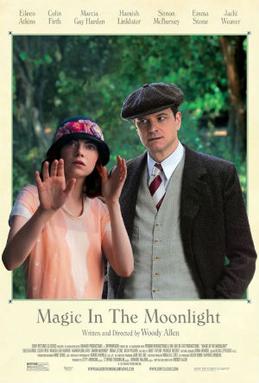
Less than Magical: Magic in the Moonlight Review

If this looks like the poster of a bad romantic comedy, I have bad news.

There is no mystery about this being a Woody Allen film: opening titles are nearly identical to the ones I saw at the beginning of Midnight in Paris, and given that both films are set in France and deal with the fantastic almost makes Magic in the Moonlight a companion piece to Allen’s 2011 work. In a way, Magic is a love letter to the French Riviera as many shots focus on the view of the sea from the verdant countryside. This will please the Francophile, but I did not fall in love with the shots. In the end, Magic in the Moonlight ends up an inferior iteration in Allen’s film catalog.

An ideal critic will no doubt cast this film in the context of Allen’s career as a whole; unfortunately, I can’t really do that. There are only three Woody Allen films that I’ve seen in their entireties: Annie Hall, Midnight in Paris, and Magic in the Moonlight. Ranking them in such a small selection is meritless since it ignores a nearly fifty years in filmmaking. And yet, I can’t help but put Magic against the other two. Annie Hall is the beloved masterpiece, Midnight is the work that reinforces audiences’ confidence in Allen’s abilities in his later years, but Magic seems to reveal a moment of weakness.

Magic is well-acted, especially with the two leads, Colin Firth and Emma Stone. Firth’s ardent skeptic Stanley plays inquisitor for Stone’s young mystic Sophie. Despite their fine performances, the chemistry between their characters feels forced in that Sophie seems to fall for the grumpy Stanley all too easily. It was as if Allen wanted us to find Stanley more charming than he truly comes across. What makes it even more infuriating is that Stanley is assuredly the Allen stand-in, giving the character a sort of Gary Stu problem in that he’s super intelligent and has a strange yet strong animal magnetism that draws in the young and naïve Sophie. Thankfully, Stanley is not depicted in such a way that he’s perfect in every aspect, but his negative qualities almost seem as they’re supposed to be overlooked.

I found myself restless throughout many moments in the movie, which is a rare thing. There’s some tension about whether or not Sophie’s truly a psychic, but never was I captivated by scenery or performances, instead wondering what would make this more than a whodunit with a love story. But it’s a bad whodunit with a weak love story. Amusing at times, but never once enthralling.

Monday, August 18, 2014

Simulacra and Simulation: “Let’s Play” and Horror Games

I openly admit to being that bastard who made others watch him play video games. My friends chide me for this, but I’ve gotten better about it. But to be honest, I’ve never had a problem with being in the passenger seat when it comes to video games. When I was 10, I’d watch my friend Sean play through the Resident Evil games because I was too freaked out to play them myself. I may still be too freaked out as I still sit on the GameCube remake of the original Resident Evil.

As the Internet has proven, I’m not the only person who can sit by while someone else wrecks zombies or sneaks past guards in games. The “Let’s Play” trend of recording one’s self while playing a video game has become a strange one at that as several YouTube channels have made money off of what is essentially a common occurrence in one’s childhood. Now that I know I could make money making others watch me play video games, I feel like I screwed up somewhere.

It’s not just the gameplay itself that draws players in, however. YouTube users like PewDiePie and Markiplier shepherded their subscriber base with amusing commentary or over-the-top reactions to video games, especially horror games. A recent upload by Markiplier shows him playing the indie horror game Five Nights at Freddy’s. In the upper left hand corner of the video, Markus “Markiplier” Fischbach sits in a computer chair with a headset on, assuming the role of the gamer. It’s only a small portion of the screen that’s taken up by Markiplier’s face, so the rest can be dedicated to the actual footage of the game. As the gameplay progresses, every reaction by Markiplier is exposed by the camera mounted near his monitor. Every scream every nervous joke is caught on camera for the viewer to see.

The practice is amusing but also voyeuristic. Without clever and judicious application of video editing, one risks revealing a great deal. I’m jumpy to begin with, so if I were to record myself playing a game like Five Nights at Freddy’s or Resident Evil, most of the footage would be me launching backwards from my chair while hyperventilating.

It’s a similar case with the YouTube channel Game Grumps that produces 10-minute clips of web celebs Egoraptor and Danny Sexbang playing vidya games both new and old. The major difference between the Grumps and other YouTube “Let’s Plays” like Markiplier’s is that the former forego the video footage of themselves (likely because there’s two of them). Their commentary is much like the rest, however—jocular, infantile, and, at times, borderline imbecilic. More recently they’ve been playing the pseudo demo for the new Silent Hills game, PT. For a few minutes today, I relived those days when I watched another blow through a scary game because I too much of a wuss to do it myself. I did the same with Markiplier’s Five Nights at Freddy’s videos.

Somehow, having that layer of separation between me and the game makes it all the less terrifying. Knowing that someone else has the reins while I can look away at my leisure gives some comfort in experiencing the game, even if it isn’t directly. If I’m playing the game myself, sure, I can pause it at any time. But at some point, I have to resume the game. At some point, I’m responsible for completing it and experiencing it. It all falls on me.

There are others who watch the Let’s Play to experience a game that they either can’t afford to or don’t have the hardware to experience it themselves. Others might just use them as previews for a game that they plan on purchasing themselves. I, on the other hand, use them to enable my own cowardice.