Wednesday, July 30, 2014

Citizen Cage: A Brief Meditation on the Merits of Nicolas Cage’s Work

I would watch this movie without the CGI.

This past season on Community, we were treated to a course at Greendale that asked the question, “Nicolas Cage: Good or Bad?” His track record over the last decade and a half has ached for the question, and as Troy puts it in the episode, “He keeps getting hired for some reason and it’s not because of his hair.” Terrible hair or not, Nicolas Cage is a perfectly capable actor who knows what he’s doing even if that means his resume looks bad after the last few years.

TMZ and other sources will no doubt remind you of Cage’s financial troubles, and while that no doubt informs his decisions to accept roles like Drive Angry or both Ghost Rider movies, I don’t believe that in influences the performances themselves. For instance, Drive Angry is an abysmal movie, but what keeps my attention throughout is Nicolas Cage’s performance. It’s by no means deserving of an Oscar, but he’s easily the best thing about it. He’s the brooding dark hero out to get revenge on the cult leader who wronged him—I forget how—who drives straight out of hell. It’s a preposterous concept, and Cage plays it straight and it works. But I don’t think it could’ve worked for anyone else.

36 of his films on Rotten Tomatoes with Tomatometer ratings are rotten, yet 29 of them are all “fresh.” Mathematically, it almost puts him as average at best if we go on ratings alone. Most of those fresh ratings are pre-2000, which is disappointing to see. His golden years were certainly the nineties, where he balanced between the action movies and dramas. Here’s where we got Leaving Las Vegas and Face/Off, Red Rock West and The Rock. There is a noticeable decline in the overall quality of the films Nicolas Cage stars in post-2000, but I don’t believe Cage’s performances do not suffer for it.

For example, in a video that has long since been deleted from the Internet by Sony’s goon squad, a behind-the-scenes featurette for Ghost Rider: Spirit of Vengeance reveals Cage’s method for depicting a vengeful flaming skull: he paints his face like a skull and hoods himself with glow sticks. I confess I haven’t seen that movie, only the BTS clip, but that can’t possibly be the work of a boringly bad actor. Over the top for sure, but never dull. You can’t look away from him.

The 2006 magnum opus to over-the-top Crank starring Jason Statham was supposed to star Nicolas Cage and was written with him in mind. It certainly seems to fit Cage’s consistently manic performances. Imagine Nicolas Cage driving through a shopping mall, chased by cops, all the while talking to Dwight Yoakum on the phone.  The fact that someone had him in mind while writing that script of madness speaks volumes about Cage’s performance.

As of this writing, Cage has seven movies coming up, two of which are sequels and one of which is a remake. They’re all over—one’s a cartoon, one’s an adventure, another’s a religiously inspired thriller. In 2011 alone, he put out five movies. He seems to be slowing down in terms of output, and I haven’t seen any of his more recent efforts. Maybe now he’s the terrible actor so many claim him to be. But they’re still watching him. 

Monday, July 28, 2014

Believing in Destiny: Exploring Bungie's Strange New World

Master Chief could have always used a cape.

Destiny is the far future incarnation of our world, evolving with the intervention of alien technology. The old world is wasteland: you find rebirth in Old Russia, where rusted cars litter the landscape and wildlife slowly retakes the buildings that stand on it. A floating orb calls itself your “ghost” and directs you to safety. You have no idea what’s happening, but you’re not supposed to. You’ve been dead for a while.

The premise is hardly new territory. Hell, at times it feels like its older brother Halo. Waves of alien troops descend upon you from spaceships, shouting their strange guttural language. You are one of the select super soldiers tasked with protecting humanity. Only there are a great deal more of you, and you’re supposed to work together.

Here we have the similar gameplay as the Borderlands series, where you go out to explore and shoot the threatening wilds. Each successful hit puts up a number to let you know how much damage you’re dealing, and there’s satisfaction in making those numbers bigger with a headshot. You level up your character through frequent firefights punctuated with minibosses. These early missions don’t provide much variety beyond go to this point and interact with something or go to multiple points and interact with more things, though that might change as the game progresses. Progress seems to move more swiftly in some aspects, however, as you’re not tied to a town hub just to get rid of gear. Within the inventory menu, pressing a button breaks down a given item into “glimmer,” the game’s currency.

My experience has been pleasurable. I don’t stop every few seconds to think how Borderlands might have done something better, so some of those comparisons may be unfair. The controls feel tight and intuitive. Crouching while sprinting makes you slide across the ground, giving you an illusion of security as you scramble for cover. Access to iron sights offers varying levels of shot precision and control. Like the game’s story, a lot of this is nothing new, but it’s virgin territory for Bungie.

Even on the PS3, Destiny is a pretty game. Perhaps it’s simply the size of my TV, but I still like the way the game works. Compared to its predecessor Halo, the colors are earthier but still colorful. Blue lights shine everywhere like K-mart was responsible for the fall of civilization, but it’s not a silly aesthetic. The armor of certain characters appear to have some pseudo-fantasy feel to them, with fur collars and the like. It’s different enough from the gamut of sci-fi shooters to give the world its own unique flavor.

The game won’t be able to avoid Borderlands comparisons, which is a shame. Destiny does a lot that Borderlands and other shooters already did, except that it attempts to do it in a larger massively multiplayer scale. To what end this scale shall manifest is still unknown to me. Missions I’ve played are limited to three players, and though the game makes matches with other players working on the same level, it seems all too random. Whether it succeeds at its MMO-like aspirations has yet to be seen, however, since we’re still in beta. It’s clear they want this to be a social game, not quite like Halo and its matchmaking, but on that grander scale. As of right now, it doesn’t offer that sense of wonder that inspires and encourages exploration that so many MMORPGs offer, but then again that may change. Until then, I’ll continue to struggle with the game’s mechanical identity.  

Saturday, July 26, 2014

Taco Time at Local Lime

Not made with real scorpions.

This past week, I had my cyclical lust for Mexican food, and while the Little Rock area has no shortage of south-of-the-border cuisine, we decided on something slightly different. Enter “Local Lime: Tacos &nd Margaritas,” the brainchild of the same folks that brought me my second favorite LR burger joint, Big Orange. I think there’s a theme.

On their website, Local Lime touts their menu as “crafted by our chefs, from scratch, using original recipes and prepared with premium ingredients (sourced locally whenever possible).” While tacos are advertised on the sign, they also pride themselves on their salsa selection which goes a step beyond the mere red and green options you might get at the average Mexican joint. Here, you pick your salsas from a menu of six options. We voted on the “Tres Chiles,” “Verde Tomatillo,” and “Mango Papaya.” I confess our waitress told us which was which, but by the time I had started dipping their “naturally gluten free” tortilla chips I had lost track of which was which. All three were good, though the Tres Chiles was different due to its soup-like temperature. I’m still unsure of how I feel about that.

The fist-sized tortillas had the appearance of handmade and not factory-spat, which was a good sign. I ordered the lunch special “Local Carnitas” taco plate containing “slow-roasted pork, pickled onion, cojita cheese, red pepper crema, [and] cilantro.” The tacos had a surprising sweetness and little bit of heat that made me lament the fact that the tacos were no bigger than my palm. But a restaurant of this sort is not the place to gorge, and the cilantro lime rice and black beans were filling. You will pay a higher premium than the average Mexican restaurant, but the quality of what you get makes it a worthy investment.

The restaurant’s overall aesthetic is very similar to its sister location Big Orange with its artisanal light bulbs and modern attitude. The while padded stools at the bar looked like props from a Cold War spy movie. They were probably very comfortable. My own seat, however, was one in which the back arm rests are a single bar shaped into a U. I didn’t care for it, though I suppose I could’ve just exchanged the seat for the one next to me.

Next time, I’ll remember to do that. 

Image credit: Local Lime.

Thursday, July 24, 2014

Your Song Sucks: What Troubles Me About Katy Perry's "Birthday"

This party apparently had two cakes.

Maybe I’m biased. Though I find Katy Perry aesthetically pleasing, I find most of her musical catalog aurally repugnant. In fact, I can’t summon a single song of hers that I can enjoy. So already I approach her single “Birthday” with skepticism and disgust after recognizing her vocal work from the get-go. She’s a capable singer, I’ll grant her that. But even though she collaborated with four other writers, the song couldn’t be any less boring or formulaic.

The lyrics aren’t subtle in the least: “Pop your confetti / Pop your perignon / So hot and heavy / ‘Til Dawn,” and later, “So let me get you in your birthday suit / It’s time to bring out the big balloons.” This isn’t to say you shouldn’t write songs about sex; Prince established a music empire solely on lyrics of lovemaking, and it’s one of the oldest subjects sang about since we discovered that our vocal cords make pretty noises. But at least make a half-assed attempt to be clever about it. The word “party” is used in that vague way that suggests more than cake and ice cream, Also, the fact that the speaker wants the subject to “pop” two different things that produce two substantially different substances makes me concerned for both parties.

The speaker is also ambiguous about her relationship to the subject. One might be quick to assume that they’re in a girlfriend-boyfriend pairing, but the opening lines suggest something far more complicated: I heard you’re feeling / Nothing’s going right / Why don’t let me / Stop By,” and later, “You know that I’m the girl that you should call.” The second passage suggests that the subject has a harem of female acquaintances that he could select from. Why would a girlfriend tell her boyfriend he can call he when he's in Frowntown? But the speaker insists that she has what it takes to turn his proverbial frown upside-down.

In spite of the speaker’s good intentions, the chorus makes me want to fall on my sword:

Boy, when you’re with me
I’ll give you a taste.
Make it like your birthday everyday.
I know you like it sweet,
So you can have your cake.
Give you something good to celebrate.
So make a wish.
I’ll make it like your birthday everyday.
I’ll be your gift
Give you something good to celebrate.

It reads like the death rattle of a metaphor. Here she uses the birthday analogy in almost every configuration uniform to the North American tradition of the birthday party. We get cake eating, wish making, gift giving—the three primary pillars stand firm even though it feels like Miss Perry and her writing collective are somehow picking up the pillars and beating me senselessly with them. Maybe that’s why the song falls apart.
After the vaguely Daft Punk-sounding bridge, Miss Perry says, “Happy Birthday” in a way that sounds like an attempt to emulate Marilyn Monroe’s famous “Happy Birthday, Mr. President.” It’s not true enough to the original to make me confident that it is in fact what she’s going for, but I’m distracted by it. I’m bothered by it.

I find the melody problematic. In spite of the song’s upbeat disco tempo, we’re left with a dull and ultimately unsexy background to supposedly sexy lyrics. The way she sings the last two words on certain lines like “’Til Dawn” and “’Stop by” feels discordant with the melody as it doesn’t quite keep up the song’s rhythm. This happens enough times that it’s noticeably awkward and feels as though they just gave up when they got to the final lines of those stanzas. The notes also sound as though they don’t offer the temporal finality that we expect from the end of a stanza. But it’s been a while since I took a music theory class so I can’t eloquently or accurately articulate what it is about the song that makes it so boring, so you’ll just have to cope with that. In a way, it looks constructed with the sort of ease of Lego, yet looks like something a three-year-old might put together with a Duplo brick: it technically fits but looks clunky and unsophisticated, and is less fun to step on.  

Monday, July 21, 2014

An X-Wing Maneuvers into a Fruit Bowl: First Impressions of the X-Wing Miniatures Game

Andrew Crivilare: "Yeah, but if they touch, ya know....stuff happens."

Somehow I got two of them on my tail. I’m on my own—far away from the fleet. We exchange misses for some time. They seem just as green as me.

Such is the scenario that played out in my mind when I took Fantasy Flight Games’ X-Wing Miniatures Game for a spin. I was outmatched against Sam’s two TIE Fighters, but my X-Wing had the advantage of durability and firepower. Still, her fighters were quick and evasive. The Star Wars-themed minis game is a quick and dirty combat game that is no doubt made more exciting with bigger ship collections.

It’s one of those rare games that’s especially friendly towards newcomers. They give you the average set of rules for a FFG product (as in a lot), but they were also so gracious to include a “Quick-Start” ruleset. Follow its instructions closely and you’ll get the basics down after one session. Given that they’re all I’ve played with so far, I’ll stick to talking about them.

Proprietary 8-sided dice forego numbers for symbols to resolve combat: red dice giveth hits and green dice taketh them away. The game provides dials for each ship so the player can select how their ship is going to move according to cardboard rulers that determine both distance and direction. Players pick their moves at once and move in order according to pilot skill. The more skillful, the faster you’ll move. However, your piloting skills come at a price: you have to wait to attack. While the rule balances out the static initiative of faster pilots, I can’t rationalize why the better pilots are worse shots. A few more games may settle this.

The game round is punctuated by four basic phases: plan your path, execute it, attack your opponent, and check for victory. Players collect damage cards as they sustain hits to their ship, which is a simple way to illustrate hit points.

The game makes a point to separate the pilot from the ship: starfighters have their own stats as do their pilots. Included with the core XMG set are two named pilots—Luke and Biggs—and several nameless ones. The Quick-Start rules mandate that you stick to the nameless ones for the sake of simplicity, which makes sense. Symbols alien to the Quick-Start rules appear on other pilot cards. I’ll get around to reading the rest soon.

In a move that reminds me of the board game Last Night on Earth, FFG included several other cardboard pieces, such as asteroids and a shuttle. After a quick glance at the full rules, it’s clear that FFG sees players’ creativity playing a part in the game’s longevity. Already included at the end are a couple of missions that complicate the game from an outright dogfight to a structured sortie. I applaud this move, which is to be expected given my high praise for FFG in the first place.

The inaugural game played out like this: 

It took us some time to get used to the maneuver patterns that are available to our ships. She scored some hits on me early on. For a long while, it was a slow awkward dance across our dinner table. At one point (pictured above), our ships nearly collided. While the rules make no adjudication about collisions in space, it's a hell of a thing trying to accurately place the rulers so movements are correct. Most of the time, I was able to evade her shots and she mine, but, despite my advantage of a shield, her shots connected and my nameless pilot was lost in a galaxy far, far away. 

Friday, July 18, 2014

An Orgy of Lights and Sounds: Making the Rounds in Tunica

There’s something to be said about casino advertising. Billboards present happy victors with their wads of cash in each hand. In lieu of past winners, you’ll see instead scantily clad women holding the same cash. “Loosest slots!” the billboards shout. They entice you to come to the smoke-smelling orgy of lights and sounds. I’m not altogether convinced the advertising is necessary.

It’s hard to tell if the people are having a good time. Looks of desperation and despair seem more commonplace than expressions of genuine glee. My parents seem like they’re having a good time. But the overall tone here is less than joyous. A man drags a woman in by the arm playfully but with purpose. A wife offers a despondent husband words of encouragement or chiding. It’s neutral at best.

Penny and nickel slots make the perimeter around the card tables. The residents of card tables seem more determined to win with studied strategies or pure luck, like gambling is more of a skill than I’m led to believe. You hear more cheers and general shouting in the center. Off in a corner sits the very exclusive high limits tables that I would love to sit in but never play. I imagine contestants from the World Series of Poker wearing sunglasses like armor, going to battle with arms of bluffing and observation. I never see anyone enter or exit that room.

This is the third time I’ve gambled at a casino. Logically, my past two experiences would have shunned me away from the practice, but this is a family get-together and I give it another go. I’m met with better luck than before. Slot machines throw free games my way, and with these free games bigger pay outs. In goes five dollars, out comes thirty dollars. Sam sits next to me, eyes wide and mouth open with a slight grin. Her luck hasn’t come yet. The Miller Lite I’m clutching was “complimentary” according to the server. Free or not, it’s there to calm my nerves and kill the stress of winning. I can climb so high but fall quickly with a loose rock.

Later, another set of free games. Bigger pay out. I’ve put in more than five dollars, but I’m still ahead. I go to the automatic cashier and finally notice the pamphlet about treating gambling addiction. It’s like reading the health warnings on packs of cigarettes. The casinos wouldn’t put this literature out if someone didn’t come and say something. I’d like to see the numbers on how many look into this treatment via a pamphlet. One casino even sponsors its own treatment facility.

Sam hits her stride. She ratchets up thirty dollars. Meanwhile, I sink twenty into a few machines. My mind starts calculating the spending in the last twenty four hours. I want to make sure I’m on track to stay ahead. I think I am. I hope I am. After the twenty dollars is officially gone and the machine tells me there are no more credits after the number dropped in forty-cent increments, I stand up. I don’t know what etiquette there is in gambling, but I assume getting up from a machine you’re not playing is one. I also feel freed when I stand, knowing that I won’t open my wallet and grab another five or twenty to feed the machine. I watch as Sam’s stride slows.

Aside from the room, we don’t pay much for this visit to Tunica. We get a complimentary voucher for the Buffet Americana for the supposed long wait we have to get checked into our room. My parents cover our dinner at another buffet at another casino, and my dad slips us each twenty five bucks to feed the slots like it’s a petting zoo. Both buffets reflect of the tone of the casino floor: neutral. But they’re buffets, AYCE, and you’ll need that nutrition if you’re going to sit at a slot all day. 

Wednesday, July 16, 2014

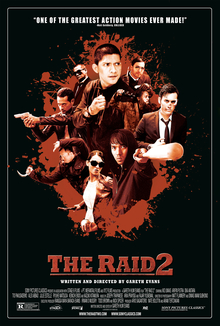
Unconventional and Improvised Weapons, The Sequel: A Review of The Raid 2

Now with less subtitle!

I was at friend’s apartment when his roommate emerged from his room with a face of satisfied exasperation. “What did you watch?” my friend asked. “The Raid,” the roommate said. Only a couple months later, the movie showed up in the Redbox near my apartment. I rented it, and then never returned it. They charged me full price for the movie. I was okay with that.

The Raid 2 I will be returning to the Redbox, but I hope to buy it later. As a sequel, it does everything it should: expands the scope of the film by upping the blood, multiplying the cast, and leaving the setting of the original. There are moments in the first movie that might make you cringe, but there are scenes that could make you outright queasy. And there’s a lot of them. For instance, in the The Raid, there’s a part where our protagonist Rama hides behind a wall from a machete-wielding thug. Suspicious of what might hide behind the wall, the thug stabs randomly. One stab grazes Rama’s cheek, and Rama must then wipe the blood off the blade as it’s retracted not to give away his presence. It’s a scene that works on multiple levels, but most importantly the fact that this is a wound that people can relate to. It’s not a terribly deep cut, and the pain is familiar enough that it might recall a memory to a previous cut. Cue the cringe.

None of that occurs in The Raid 2. The violence here is gritty but borderline fantastical compared to that of the original. It seems outrageous at times, but it’s mesmerizing to watch. There’s a scene in which a woman wearing sunglasses armed with two claw hammers takes out at least six men with Japanese daggers. The camerawork is intimidate since we’re on a subway train, and the woman makes liberal use of the claw side of the hammer. As you can guess, blood comes out in buckets during this scene, and it lasts all of about a couple minutes. The sounds, the close-ups of hammer claws buried into necks are harder to watch than in the first movie. Then again, The Raid 2 is more dangerous. The stakes are higher.

The Raid 2 is an immediate continuation of the first film. The traitor of the first film is seen at its beginning, and Rama is convinced to assist a cop with infiltrating a mob. His only qualifications for this are that he can kick a metric ton of asses and that he came out mostly unharmed from the titular raid of the first film. Of course, the cop makes a deal Rama can’t refuse: he’ll protect Rama’s wife and son. The wife is pregnant at the beginning of the first film. Rama is established as a family man both in trying to retrieve his gangster brother and saying reserved goodbyes to his pregnant wife. The family man angle is turned against him in The Raid 2, which makes Rama’s plight all the more engaging.

There’s even a running theme of distant fathers throughout the movie, as Uco vies desperately for his gangster father’s approval, a shabby hitman wants to reconnect with his son, and Rama stays in quiet contact with his wife. Due to this desire to introduce more plot and conflict, the film suffers at time in its pacing. At nearly two and a half hours, it’s a gamble to increase the exposition in a film that about dudes beating up other dudes, and the moments of downtime takes away that breakneck pace that we get in the original film. Also, dad conflicts are too convenient for a movie like this, but it helps to emphasize Rama’s concerns about staying alive long enough to be a dad.

Beyond fatherhood, Rama also evolves in fighting style. He takes on the persona of Yuda, a young hood who ends up in prison kicking the crap out of someone. He then befriends Uco, the heir of a crime family in Jakarta, in an attempt to infiltrate Uco’s syndicate. When not fighting, Rama comes across as an earnest worker doing the best that he can. However, when locked in combat, he becomes more brutal, nearly sadistic, than we see in the first film. In The Raid, he’s fighting for survival. In The Raid 2, there’s something else. It’s never clear if this propensity to violence is merely him maintaining his façade of Yuda, but it’s clear that we have a different Rama than in the first movie.

In spite of the film’s iffy pacing, The Raid 2 must be praised for its cinematography. Color palettes are played with in a noticeable and intriguing way. One setting in particular is saturated with red, giving the impression that the film is culminating to a bloody conclusion, which is accurate. That camera work has its moments of shakiness but it’s never in a nauseating way. There is, however, a car chase that does some bold moves with camera work in which the camera seems to fly into the passenger seat of a car but from a great distance in front of that car. A moment like that car chase reminds me why I was excited about the movie. The Raid 2 is the bigger, badder sequel that we thought we wanted. It’s still immensely fun to watch, but in trying to make more plot, it loses the charming relentlessness of the original.